
|

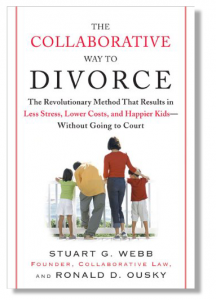
THE COLLABORATIVE WAY TO DIVORCE:
The Revolutionary Method that Results
in Less Stress,
Lower Cost, and Happier Kids—Without Going to
Court
By Stuart G. Webb & Ronald
D. Ousky
In THE
COLLABORATIVE WAY TO DIVORCE: The Revolutionary Method
that Results in Less Stress, Lower Cost, and Happier
Kids—Without Going to Court (Hudson Street Press;
June 2006 , $23.95) collaborative
law founder and pioneer Stuart G. Webb & Ronald
D. Ousky provide a groundbreaking alterative for the
millions of couples with children who face divorce each
year—couples who want to avoid litigation, but
don’t want to give up on getting what they want.
Compassionate,
clear, and comprehensive, THE COLLABORATIVE WAY TO DIVORCE
is the first trade book to introduce a dignified, highly
strategic solution to divorce-- the collaborative process,
a nationally acclaimed approach that is fast transforming
how couples dissolve their marriages, divide their assets,
and reinvent their post-divorce relationships, particularly
when they share custody of their children. Centered
around the understanding that the couple will hire their
own individual collaborative attorneys—but all
are committed, in writing, to settling their differences
out of court--THE COLLABORATIVE WAY TO DIVORCE
stresses cooperation over confrontation and resolution
over revenge. Most importantly, it keeps children out
of the controversy, while protecting their best interests.
For
the millions of couples who face divorce each year,
The Collaborative Way to
Divorce offers an alternative to court—without
giving up getting what you want
Even
under the best circumstances, divorce can be marked
by a range of painful emotions. But research now reveals
that how a couple conducts themselves during
a divorce has far greater impact on their children than
the act of divorcing itself. Groundbreaking and revolutionary,
The Collaborative Way to Divorce
is the first guide to the Collaborative process, a nationally
acclaimed approach based on the concept that both spouses
hire legal representation, yet agree to resolve their
differences with no intention of ever going to court.
Stressing
cooperation over confrontation and resolution over revenge,
Collaborative divorce is fast transforming how couples
dissolve their marriages, divide their assets, and reinvent
their post-divorce relationships, particularly when
they have children. Written by Stu Webb, the founder
of the Collaborative law movement and Ron Ousky, an
early pioneer of the process, The Collaborative
Way to Divorce guides you through the steps
of the Collaborative process so that you can make better,
more informed, and more strategic decisions—resulting
in a win-win outcome for you and your spouse.
_________________________
“Invented
more than a decade ago by Stuart G. Webb, [collaborative
divorce] is gaining in popularity around the nation.”--
The New York Times
“An increasingly popular process that is often
faster, cheaper, and more private than standard courtroom
divorces, not to mention less emotionally taxing.”--
The Wall Street Journal
MEDIA
COVERAGE
Since the
book's release on May 18, 2006, we have received a great
deal of inquiry from the media including the following:.
TAPED:
BROADCAST TIME
| TIME
|
MARKET
|
STATION
|
PROGRAM
|
| May 24, 2006 |
|
|
|
| 7:15
A.M EST |
MIAMI |
WIOD-AM |
FIRST NEWS
LIVE |
| 7:50 A.M. EST |
ORLANDO |
WLRQ-FM |
MIKE & MINDY |
| TAPED: BROADCAST TIME TBD |
REGIONAL
FLA |
FLA REGIONAL
NETWORK |
SMITH & REILLY |
| TAPED: BROADCAST TIME TBD |
ATLANTA |
WVEE-FM |
FRANK & WANDA |
| TAPED: BROADCAST TIME TBD |
RICHMOND |
WMXB-FM |
MORNING
SHOW |
| TAPED:
BROADCAST TIME TBD |
GRAND
RAPIDS |
WGVU-AM
(NPR) |
MORNING
SHOW |
| 8:50
A.M. EST |
NATIONAL |
ABC RADIO
NETWORK |
JONATHAN & MARY |
| 9:00
A.M. EST |
REGIONAL
CO |
KCMN-AM |
TRON
TALK |
| 9:10
A.M. EST |
MILWAUKEE |
WMYX-FM |
MIX
MORNING SHOW |
| TAPED:
BROADCAST TIME TBD |
NATIONAL |
VOICE
OF AMERICA |
NEWS
TAPE |
| 9:40
A.M. EST |
GREEN
BAY |
WFON-FM |
JOHN & MARY SHOW |
| TAPED: BROADCAST TIME TBD |
KANSAS CITY |
KKXX-FM |
MORNING
SHOW |
| 10:30
A.M. EST |
MINNEAPOLIS |
WXCE-AM |
MORNING
NEWS |
| TAPED:
BROADCAST TIME TBD |
BOSTON |
WDIS-AM |
TALK
OF THE TOWN |
| TAPED: BROADCAST TIME TBD |
REGIONAL
TN/AL |
WYDL-FM |
NUTS
IN THE AM |
| May 25, 2006 |
|
|
|
| 8:20
A.M. EST |
REGIONAL
NJ/NY |
WTBQ-AM |
MORNING
SHOW |
| 9:15 A.M. EST |
DES MOINES |
LGGO-FM |
MORNING
SHOW |
| 9:30
A.M. EST |
NATIONAL |
RADIO AMERICA |
DOUG STEPHAN
SHOW |
| TAPED:
BROADCAST TIME TBD |
TUSCON |
KUAT-AM/FM
(NPR) |
NEWS
FEATURE |
| May 27,2006 |
|
|
|
| 9:00 A.M. |
Washington D.C. |
WHUR |
Audrey Chapman Show |
| May 28, 2006 |
|
|
|
| 1:00
PM- P.M Central |
Minneapolis |
FM
107 |
JONATHAN
FOGEL |
The
Collaborative process is beneficial in that it:
▪
is generally less expensive and quicker than litigation
▪
keeps your children out of the controversy, and the
controversy to a minimum
▪
gives you greater control over the outcome of your
divorce
▪
helps maintain a sense of integrity and respect between
you and your partner
Compassionate
and comprehensive, The Collaborative Way
to Divorce offers a dignified, effective
solution to one of life’s most difficult—and
emotionally charged—situations. Collaborative
divorce isn’t about “going easy” on
your spouse. It’s about ending up with more money,
less stress, and happier kids, without going to court.
What
others are saying about the Collaborative Way to Divorce:
“Every
divorcing parent should read this enormously helpful
book and learn how hiring the right kind of lawyer—one
committed to collaborative problem solving—can
reduce the daunting economic and emotional pain of divorce.”
—Robert H. Mnookin, Williston Professor
of Law, Chair, Program on Negotiation, Harvard Law School
"If
you are considering divorce, the collaborative law process
described in this book will show you how to navigate
your course to a good divorce. In this
clear step-by-step guide, lawyers Webb and Ousky outline
a method for reducing conflict that is certain to have
lasting benefits for you and your children."
—Constance R. Ahrons, Ph.D., psychologist
and author, The Good Divorce
and We're Still Family
"Grounded
in practical wisdom, this book illuminates with clarity
and kindness a collaborative alternative to traditional
litigation. If you care about your kids, value your
dignity and seek to shape your own future, The Collaborative
Way to Divorce will light your way."
—Talia L. Katz, JD, Executive Director, International
Academy of Collaborative Professionals
“A new, much-needed option for divorcing couples
is now available. Here are two lawyers who have worked
to improve and change the adversary system themselves,
creating a more constructive way to manage this difficult
life transition. Collaborative divorce should be a serious
consideration for anyone divorcing.”
—Vicki Lansky, author of Divorce
Book for Parents and It’s Not Your Fault,
Koko Bear
“With
the distilled clarity with which he created the Collaborative
Law model, Stu Webb, along with his co-author Ron Ousky,
has created a straightforward and informative introduction
to the Collaborative divorce process. This book should
be mandatory reading for anyone contemplating divorce
and a handbook for anyone who wishes to protect their
children and their finances by using the collaborative
approach.” —Chip
Rose, J.D. Mediator, Collaborative Attorney, Trainer
Some of the
ways in which the collaboratrive method differs from
traditional divorce as illustrated in THE COLLABORATIVE
WAY TO DIVORCE are:
Finding
and hiring an attorney
In traditional
divorce Clients conduct separate searches,
each aiming to hire an aggressive litigator who is “good
in court.”
In collaborative
divorce Clients coordinate their search for
attorneys; both agree to hire Collaborative Attorneys.
Starting
the divorce process
In traditional
divorce the husband or wife prepares (with
the help of an attorney) a Summons and Petition. The
Summons and Petition is then filed with the court and
a judge is assigned to case.
In a Collaborative
divorce, both clients and their attorneys,
meet for a four-way conference to discuss how everyone
wants the case to proceed. At that first conference,
all parties sign the Participation Agreement, which
commits all involved to resolving all issues out of
court.
Addressing
temporary issues
(e.g.,
who will reside in the house, how much time children
will spend at each home, etc., while divorce proceedings
are taking place)
In traditional
divorce, clients who cannot resolve temporary
issues on their own may seek a temporary hearing. At
the hearing, each client and his/her attorney files
a motion and affidavits, then the opposing client/attorney
argues against the spouse’s requests. The parties
then go to court, where a judge issues a temporary order.
In collaborative
divorce, temporary issues are handled by agreement
at one of the initial four-way meetings, through a method
of interest based negotiation that helps the parties
focus on common goals and interests.
Guiding readers
through the steps of the collaborative process so that
they may make better, more informed decisions, THE
COLLABORATIVE WAY TO DIVORCE isn’t about
“going easy” on your spouse. It’s
about ending up with more money, less stress, and happier
kids without going to court.
ABOUT
THE AUTHORS:
Stuart
G. Webb invented collaborative law in 1990.
He trains and lectures throughout North America and
Europe; he has appeared in The New York Times and
The Wall Street Journal, and (with Ron Ousky)
on the CBS Evening News.
Ronald D. Ousky
is a pioneer of collaborative law and a board member
of the International Association of Collaborative Professionals.
Differences Between Traditional Divorce and Collaborative
Divorce
The 8
Stages of Divorce |
Traditional
Divorce |
Collaborative
Divorce |
1) Finding and hiring an attorney
|
Clients conduct separate
searches, each aiming to hire an aggressive litigator
who is “good in court.” |
Clients coordinate
their search for attorneys; both agree to hire
Collaborative Attorneys. |
2) Starting the divorce process
|
Husband or wife prepares
(with the help of an attorney) a Summons and Petition.
The Summons and Petition are filed with the court
and a judge is assigned to case. The spouse then
files an Answer and Counter-Petition. |
Both clients and their attorneys meet for a four-way
conference to discuss how everyone wants the case
to proceed. At conference, all parties sign a
Participation Agreement, which commits all involved
to resolving all issues out of court. If the case
cannot be resolved out of court, the attorneys
are required to withdraw from the case.
|
3) Addressing temporary issues
(e.g.,
who will reside in the house, how much time children
will spend at each home, etc., while divorce proceedings
are taking place)
|
Clients who cannot
resolve temporary issues on their own or seek
relief through a temporary hearing. At the hearing,
each client and his/her attorney files a motion
and affidavits, then opposing client/attorney
argues against spouse’s requests. Finally,
all parties go to court, where judge issues temporary
order for issues. |
Temporary issues
handled at one of the initial four-way meetings
through an interest based method of conflict resolution
that helps the parties focus on common goals.
|
4) Gathering and exchanging information
(e.g.,
information about the value of assets, each client’s
basic income, monthly expenses for family, etc.)
|
Attorneys collect
and exchange information through formal discovery,
which includes interrogatories, requests
for documents, and depositions.
|
Each party is required
to voluntarily disclose all relevant facts through
an informal (and less expensive) exchange of information.
|
5) Hiring Experts
(To obtain information outside the expertise of
their attorneys — the value of their home,
business, pension, etc.)
|
Each side may hire
its own experts. |
Both sides use same,
neutral experts, which they have agreed
upon together. |
6) Negotiating a settlement
|
Handled by the attorneys and presented as arguments in
favor of each of their client’s positions.
(Clients not directly involved in settlement discussions.)
|
Worked out by attorneys
and clients at four-way meetings, through interest
based on negotiation that focuses on common goals.
|
7) Getting a “final” divorce decree
|
If case doesn’t settle, goes to trial, where
clients testify/provide more evidence. At end
of the trial, attorneys submit written arguments/proposals.
Weeks or months after trial, judge issues a decision
on all issues.
|
Final divorce documents
the result of an agreement devised and signed
by both parties. |
8) Resolving issues that arise after the divorce
|
Clients must go to
court to solve problems. |
Clients resolve issues
on own, by applying same principals that led to
the agreement in the first place. |
THE
COLLABORATIVE WAY TO DIVORCE
How the Collaborative Method Offers Less
Stress, Lower Cost, and Happier Kids—Without Going
to Court
By Stuart G. Webb, Founder, Collaborative
Law, and Ronald Ousky
6 x 9 ▪ 288 pp. ▪ Family
and Childcare ▪ ISBN: 1-59463-022-4
Back
to Top
|